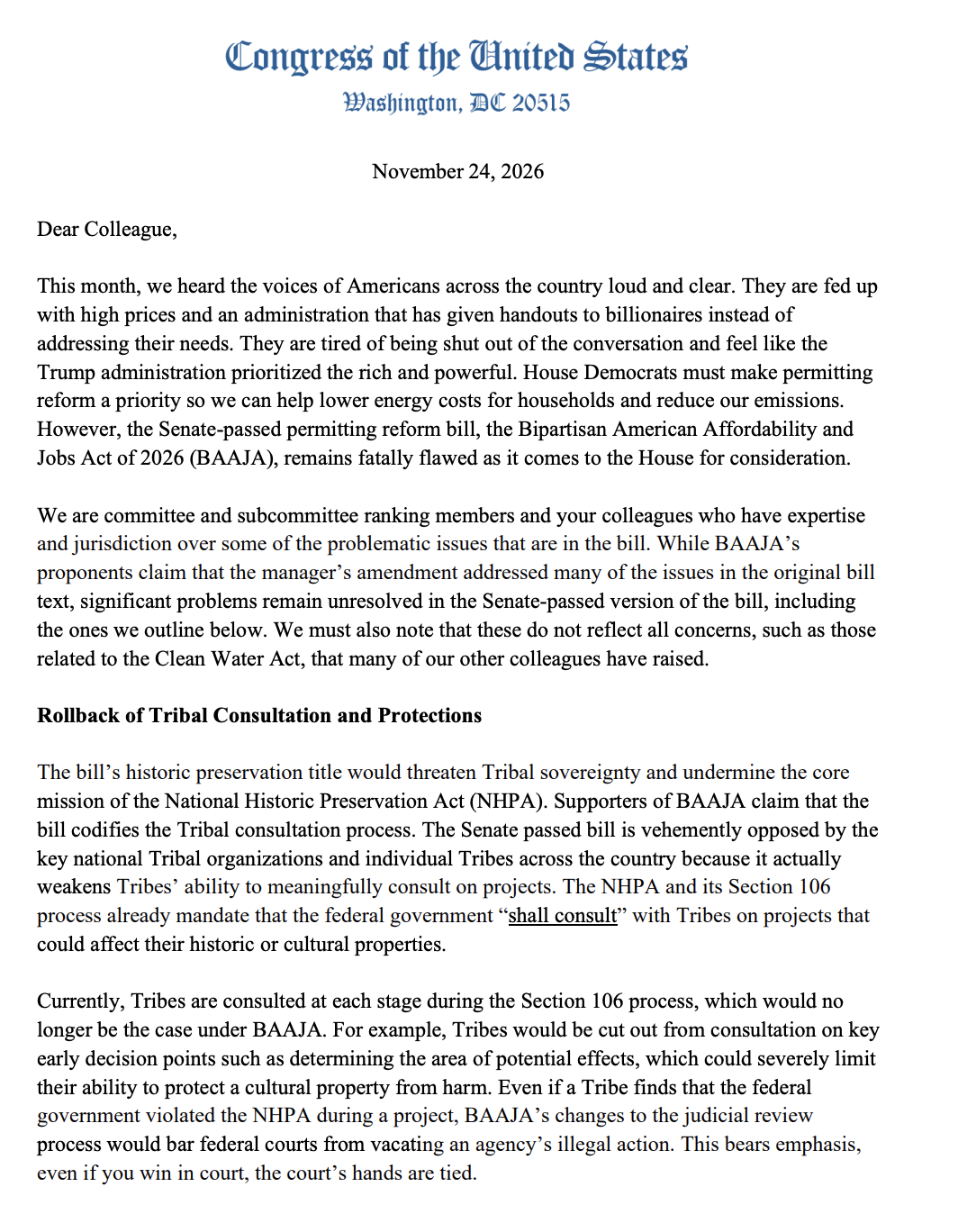
In a letter to their colleagues, House Democrats with jurisdiction over public lands and Tribal consultation warn that that the industrial-expediting legislation BAAJA is “fatally flawed.”
Reps. Teresa Leger Fernández, Jared Huffman (D-Calif.), Betty McCollum, Chellie Pingree (D-Maine), Melanie Stansbury (D-N.M.), Gabe Vasquez (D-N.M.), and Maxine Dexter (D-Ore.) signed the letter.
Rep. Huffman is the ranking member of the Committee on Natural Resources; Rep. Fernández is the ranking member of the committee’s Subcommittee on Indian and Insular Affairs and a member of the House Rules Committee; Rep. Dexter is ranking member of the Subcommittee on Oversight and Investigations; and Rep. Stansbury a member of the Federal Lands and Water, Wildlife, and Fisheries subcommittees.
Rep. Vasquez is the founder and co-chair of the bipartisan Public Lands Caucus, and a member of the Agriculture Committee and Armed Services Committee.
Reps. McCollum and Pingree serve on the Appropriations Committee: Pingree is ranking member of the Interior-Environment Subcommittee and a member of the Agriculture Subcommittee; McCollum is ranking member of the Defense Subcommittee and a member of the Interior-Environment Subcommittee.
November 24, 2026Dear Colleague,
This month, we heard the voices of Americans across the country loud and clear. They are fed up with high prices and an administration that has given handouts to billionaires instead of addressing their needs. They are tired of being shut out of the conversation and feel like the Trump administration prioritized the rich and powerful. House Democrats must make permitting reform a priority so we can help lower energy costs for households and reduce our emissions. However, the Senate-passed permitting reform bill, the Bipartisan American Affordability and Jobs Act of 2026 (BAAJA), remains fatally flawed as it comes to the House for consideration. We are committee and subcommittee ranking members and your colleagues who have expertise and jurisdiction over some of the problematic issues that are in the bill. While BAAJA’s proponents claim that the manager’s amendment addressed many of the issues in the original bill text, significant problems remain unresolved in the Senate-passed version of the bill, including the ones we outline below. We must also note that these do not reflect all concerns, such as those related to the Clean Water Act, that many of our other colleagues have raised.
Rollback of Tribal Consultation and Protections
The bill’s historic preservation title would threaten Tribal sovereignty and undermine the core mission of the National Historic Preservation Act (NHPA). Supporters of BAAJA claim that the bill codifies the Tribal consultation process. The Senate passed bill is vehemently opposed by the key national Tribal organizations and individual Tribes across the country because it actually weakens Tribes’ ability to meaningfully consult on projects. The NHPA and its Section 106 process already mandate that the federal government “shall consult” with Tribes on projects that could affect their historic or cultural properties.
Currently, Tribes are consulted at each stage during the Section 106 process, which would no longer be the case under BAAJA. For example, Tribes would be cut out from consultation on key early decision points such as determining the area of potential effects, which could severely limit their ability to protect a cultural property from harm. Even if a Tribe finds that the federal government violated the NHPA during a project, BAAJA’s changes to the judicial review process would bar federal courts from vacating an agency’s illegal action. This bears emphasis, even if you win in court, the court’s hands are tied.
Moreover, the legislation provides incredible deference to the federal government to move forward with a project that could harm a historic property if, in the “sole discretion” of a federal official, “other considerations outweigh the consideration of historic preservation.” This applies to all historic properties, not just Tribal. We don’t believe we should give “sole discretion” to the Trump administration or any future administration to decide that Tribal concerns don’t deserve consideration. We have seen Trump ignore existing law to pursue his vanity projects like the triumphal arch. BAAJA would codify Trump’s behavior, and we don’t trust him to use the “sole discretion” authority in a manner that respects our country’s cultural and historical heritage.
These changes to the NHPA go far beyond reform; they are a fundamental rewriting of our historic preservation laws that cut out the communities the NHPA is supposed to protect. We also believe this destruction of the consultation process is not necessary. Consultation on historic preservation starts the conversations that often make the project better and help prevent litigation down the line.
Data Center Permitting
We applaud the provisions of the bill that would help protect ratepayers from data center development. However, the claim that the bill does nothing to help ease federal permitting for data centers is simply false. The Bureau of Land Management is actively considering at least 17 data centers on federal lands out West. These types of projects on federal land or for some of these pipelines that would power a data center would normally be subject to the National Environmental Policy Act, the NHPA, the Endangered Species Act, and the Clean Water Act, all of which BAAJA weakens to favor the project sponsor. As currently drafted, BAAJA would help fast-track data center development on federal lands and severely limit public input into these projects.
Our constituents are incredibly upset that data centers are moving forward without community input on issues ranging from clean water use to carbon emissions. BAAJA would exacerbate that exclusion of local voices in the permitting process for data centers.
Loss of Protections for Landscapes
The “project certainty” provisions in the bill threaten our public lands, including sacred spaces and priceless wilderness. These provisions would permanently lock in the Trump administration’s agenda to sell out our most treasured public lands to extractive industries— putting at risk the Arctic National Wildlife Refuge, Chaco Canyon, Bears Ears National Monument, and the Boundary Waters. The threat to the Boundary Waters is existential. The Boundary Waters is America’s most visited wilderness, a vast system of interconnected lakes, rivers, streams, and wetlands with water clean enough to drink. This wilderness is under assault from this administration, which is working expeditiously to authorize a sulfide-ore copper mine in the headwaters of the Boundary Waters for Chilean and Chinese interests. If this administration issues mining leases and approves a mine plan on its current schedule, the federal authorization for this mine would be nearly impossible for any future administration to unwind.
Our public lands are a legacy we hold in trust for future generations. We cannot allow this administration to bind its successors, and the public, to a decision that can never be undone.
Changes of this magnitude to bedrock laws deserve an open and transparent process. They deserve committee hearings, and a review of unintended consequences. We need time to review the potential impact on costs, clean water, pollution, carbon emissions, and impact on local and Tribal communities. Legislation that impacts so many of our bedrock principles should not be drafted behind closed doors.
We urge you to oppose BAAJA as currently drafted and join us in requesting a legislative process that will allow for meaningful consideration of this bill in the House, including hearings, markups, and an amendment process. As members with expertise on these issues, we know that we can pass a permitting reform bill without eroding Tribal sovereignty and key protections.
Sincerely,
TERESA LEGER FERNÁNDEZ Member of Congress
JARED HUFFMAN Member of Congress
BETTY MCCOLLUM Member of Congress
CHELLIE PINGREE Member of Congress
MELANIE STANSBURY Member of Congress
GABE VASQUEZ Member of Congress
MAXINE DEXTER Member of Congress