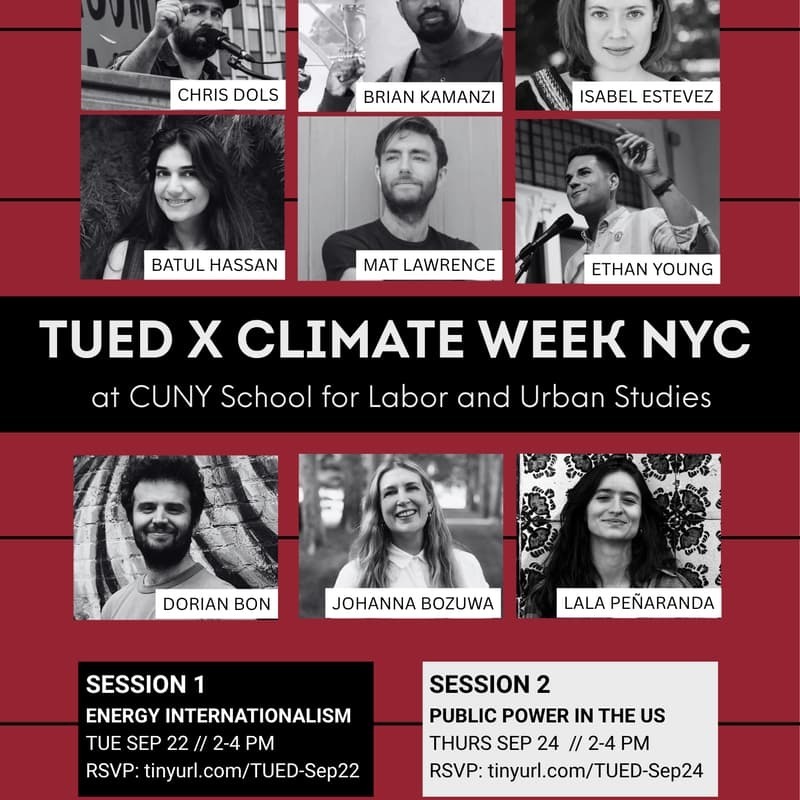
This Climate Week NYC 2026 event will focus on the core principles of the Public Pathway and what they mean in the New York and U.S. context. While TUED has focused on the Public Pathway in an international context to describe reclaiming energy from neoliberal privatization, the underlying principles are directly relevant to struggles in the US and New York: public ownership of energy, democratic governance of public services, utility accountability, visionary energy planning by the state, decarbonization of built infrastructure, public transit, robust workers’ rights, affordable housing, affordable energy bills, and the defense of quality public services.
Climate policy cannot succeed if it is organized around fragmented private, profit-maximizing markets, cost-shifting to working people, and “green privatisation” projects designed primarily for investor returns.
Panelists will explore several guiding principles of the Public Pathway, including energy as a public good, progressive climate finance, workers’ use of public procurement and industrial policy, and the need to link climate action with a robust labor movement. The discussion will connect these principles to concrete U.S. and New York debates, including public power, the role of NYPA, utility regulation, green jobs, electrification, public housing retrofits, public transit expansion, and local industrial strategy.
Speakers:
- Isabel Estevez, Co-Executive Director, i3T
- Chris Dols, Federal Unionist Network, Organizer
- Batul Hassan, Labor Director at the Climate and Community Institute
- Lala Peñaranda (moderator), Latin America Coordinator, Trade Unions for Energy Democracy (TUED)
Part of TUED X Climate Week NYC at CUNY School for Labor and Urban Studies.
CUNY School of Labor and Urban Studies
25 W 43rd St 18th floor
New York, NY 10036