Rep. Sean Casten: BAAJA Could Spur a 'Gold Rush For Gas'

Posted by Brad Johnson on 10/30/2026 at 05:11PM

At a conference at the University of Chicago on Tuesday, Rep. Sean Casten (D-Ill.) expressed his concerns with BAAJA (S. 5653), particularly in the real-world context of rising data-center demand, a lawless Trump administration, economic headwinds for the renewable industry, and preparations for rapid acceleration of natural gas extraction and infrastructure.

Interviewed by Axios reporter Amy Harder, Casten stated he could “not yet” support the bill, particularly as it could “create a gold rush for gas.”

“Anybody who is telling you that they can model the effects of this bill is telling you what their opinion is,” Casten warned. “They’re not telling you facts because when you have a White House that is not obeying the law, I don’t know how to model a change in law.”

Watch:

UPDATE 11/4: Casten offered further remarks in a press briefing after the elections. He raised concerns that the bill’s provisions “depend on a White House that is willfully violating the law every day to implement” but said “it’s important to withhold any judgment about what is in that bill until we see the manager’s amendment.”

Full transcript of U Chicago remarks:

Tags:

Protecting Indigenous Lands and Cultural Sites from Deregulation in the Bipartisan American Affordability and Jobs Act

Join the webinar on Friday, October 30 at 1pm ET/12pm CT/10am PT to hear from Tribal leaders and Federal Indian Policy experts about how the Bipartisan American Affordability and Jobs Act would undermine important government-to-government Tribal consultation practices, leave Tribal lands and waterways unprotected, and take away Tribal Nations’ right to protect sacred and cultural sites.

Presenters:

  • James Floyd, Board of Trustees for National Parks Conservation Association and former Principal Chief of the Muscogee Nation
  • Christie Modlin, Tribal Secretary for the Iowa Tribe of Oklahomas and Recording Secretary for National Congress of American Indians
  • Valerie Grussing, Director of Legislative Affairs and Strategic Partnerships at the National Asociation of Tribal Historic Preservation Officers

RSVP

Climate Justice Alliance
10/30/2026 at 01:00PM

Tags:

Stop the Dirty Deal: Take Action on the Proposed Bipartisan American Affordability and Jobs Act

Congress is considering major changes to federal permitting laws that could reshape how fossil fuel infrastructure, data centers, and other large projects are approved, and how much say communities have in those decisions.

​Join Climate Justice Alliance, Center for Biological Diversity, and AI Now Institute for an interactive session where we’ll break down the proposed Bipartisan American Affordability and Jobs Act (BAAJA) and provide easy ways to take immediate action.

​The session will be led by:

  • Mar Zepeda Salazar, Legislative Director, Climate Justice Alliance
  • Ben Goloff, Senior Climate Campaigner, Center for Biological Diversity
  • Sophie Song, Data Center Policy Fellow, AI Now Institute

​We’ll start with a short explanation of the proposed legislation and then move into an interactive, action-oriented session. The goal is to help people understand what’s in the bill, what it could mean for their communities, and what they can do to make their voices heard.

​Whether you have five minutes or an hour, we’ll share practical tools for contacting members of Congress, writing letters to the editor, creating social media messages, and organizing with others in your community.

​Read and Share the Permitting Bill Resource Document

​Come with your questions, your experiences, and a willingness to participate! We’ll provide resources, sample language, and opportunities to connect with others.

RSVP

Halt the Harm Network
10/29/2026 at 03:00PM

Tags:

BAAJA Follies: The Trump Arch

Posted by Brad Johnson on 10/28/2026 at 08:26PM

If enacted, the lame-duck industrial-expediting bill BAAJA (S. 5653) will provide blanket permission for Trump’s destructive wishes in our nation’s capital. In BAAJA Follies, Hill Heat reviews several of the major legal battles against that takeover, and the implications of BAAJA’s possible passage during the lame-duck session.

Lemmon v. Trump and County Board of Arlington v. NPS and District of Columbia v. NPS

If BAAJA passes, most of the legal avenues for opponents of the construction of the Trump arch will be narrowed or shut down.

In October 2025, Trump announced his plans for a gargantuan and garish “triumphal arch” blocking the view of the Lincoln Memorial from Arlington National Cemetery. He has since announced it will also serve as a new, mechanized military outpost with drones and snipers, a claim confirmed in October 2026 in affadavits by Secretary of Homeland Security Markwayne Mullin and Secretary of Defense Pete Hegseth.

Represented by Public Citizen, three Vietnam veterans and an architectural historian brought suit in February against the arch’s construction, citing the Commemorative Works Act, NEPA, and the National Historic Preservation Act (NHPA).

In April, Trump’s CFA voted for the arch.

In June, the National Parks Service issued a rushed environmental impact assessment under NEPA, with a finding of “no significant impact”; they then avoided soliciting comment on the environmental assessment.

Also in June, they published an assessment of effect on historic sites under NHPA’s Section 106, finding dozens of adverse effects on the sanctity of those sites, but then invited only ten days of public comment. In July, they reopened twenty more days of public comment after complaints from the District of Columbia Historic Preservation Office and the Virginia Department of Historic Resources. In August, after receiving overwhelmingly negative comments, NPS issued a revised Section 106 statement finding even more adverse effects. In September, they issued a proposed historic-preservation agreement, admitting “adverse effects cannot be fully avoided” but that “the proposed location at Memorial Circle is central to the undertaking” and thus no alternative course of action could be considered.

Meanwhile, Secretary Burgum posted renderings of the arch and announced “excavation work” would begin mid-September, so plaintiffs filed for a restraining order, which was granted.

Sen. Martin Heinrich (D-N.M.)—as he was negotiating legislation to kill section 106 of the NHPA—led a September 22 letter to Interior Secretary Doug Burgum against the Arch, citing “section 106 of the National Historic Preservation Act,” which requires the government to “avoid, minimize, or mitigate” adverse harm to historic sites. The letter was co-signed by U.S. Senators Angus King (I-Maine), Alex Padilla (D-Calif.), Ron Wyden (D-Ore.), Mazie Hirono (D-Hawaii), and Chris Van Hollen (D-Md.).

Tags: ,

BAAJA Follies: Hains Point and East Potomac Park

Posted by Brad Johnson on 10/28/2026 at 08:00PM

If enacted, the lame-duck industrial-expediting bill BAAJA (S. 5653) will provide blanket permission for Trump’s destructive wishes in our nation’s capital. In BAAJA Follies, Hill Heat reviews several of the major legal battles against that takeover, and the implications of BAAJA’s possible passage during the lame-duck session.

DC Preservation League v. Interior

Trump has been pressing forward to replace D.C.‘s historically important public park on Hains Point with Trump-style golf course. The passage of BAAJA would likely eliminate all legal means of opposition to Trump’s Hains Point plans.

As mentioned above, the Trump regime used Hains Point as the illegal dumping ground for the East Wing demolition. In December, Trump killed the leases held by the National Links Trust for D.C.‘s public golf courses, and the Wall Street Journal revealed Trump and Burgum had secretly discussed remaking the East Potomac Golf Links on Hains Point. In February, the DC Preservation League brought suit, represented by Democracy Forward. In April, Burgum’s lawyers told Judge Ana Reyes no decisions had been made on renovating the park, but at the beginning of May, NOTUS reported that “landscaping, deferred maintenance and tree-clearing work in line with the National Park Service’s pre-approved plans” were about to begin. A hasty court meeting was called and the judge ordered the regime “not to cut down more than 10 trees without first notifying plaintiffs and getting court approval.” A few days later, Burgum publicly revealed the planned redesign of Hains Point.

Contractors cut down hundreds of trees in October, spurring an angry rebuke from the judge and a restraining order blocking all new tree-cutting, with demands for phones and documents as Trump’s lawyers say one thing in court and Trump says the opposite in public.

At the moment, Trump’s plans are being restrained. However, if Congress passes BAAJA, the illegal dumping, illegal plans, and illegal destruction of historic places will become legal. The plaintiffs’ entire case will collapse, giving Trump near-total power over the future of Hains Point and East Potomac Park.

“Historical preservation matters to me,” Save East Potomac’s Alex Rosen told Hill Heat in a phone interview. “Expanding executive power, especially under this administration, is fucking unbelievable.”

Save East Po is encouraging people across the nation to contact their members of Congress to stop BAAJA.

UPDATE Nov. 2: “A federal judge has already stepped in more than once to stop unlawful actions there, catching rushed paperwork and misleading claims from federal officials,” the D.C. Preservation League said in a statement to Politico. “That only works because courts can still meaningfully review agency action, and the public still has a real voice in the process. BAAJA would weaken both.”

Tags: ,

BAAJA Follies: The White House East Wing Ballroom Case

Posted by Brad Johnson on 10/28/2026 at 07:37PM

If enacted, the lame-duck industrial-expediting bill BAAJA (S. 5653) will provide blanket permission for Trump’s destructive wishes in our nation’s capital. In BAAJA Follies, Hill Heat reviews several of the major legal battles against that takeover, and the implications of BAAJA’s possible passage during the lame-duck session.

National Trust for Historic Preservation v. National Park Service and NPS v. NTHP

With the East Ballroom, Trump is actively building a new, hardened military bunker in the White House, surmounted by a gaudy monument to himself. The Supreme Court killed a judicial stay on Trump’s illegal construction spree with the reasoning that historic preservationists can’t be harmed by the destruction of historical architecture, a ruling consistent with the text of BAAJA.

Over the course of a few days in October 2025, Trump contractors demolished the White House East Wing, illegally dumping thousands of cubic yards of debris in Hains Point, the site of the East Potomac Golf Course. The National Trust for Historic Preservation immediately brought suit against the construction of Trump’s ballroom under the National Capital Planning Act, the National Environmental Policy Act (NEPA), and the Administrative Procedure Act. In March, a district court judge issued an injunction against the ballroom, but an appeals court soon lifted that stay, allowing construction to proceed, but in August the full court agreed with the injunction, stopping construction again. On an emergency basis, the Supreme Court ruled in favor of Trump on August 31st by a vote of 5-4, overriding John Roberts and the liberal justices.

The right-wing ruling claimed the plaintiffs lacked standing, by finding that D.C. architectural historian Alison Hoagland would not be harmed in a concrete way by the destruction of the republican aesthetics of the People’s House. BAAJA’s radical restrictions of both standing and “adverse effects” parallel this ruling.

The strongest course of action for a potential Democratic Congress in January would be investigations with subpoenas of the ballroom donors, construction process, and ballroom blueprints. If the White House refused, they could immediately file suit and pursue a judicial stay on construction during the subpoena fight. Again, the passage of BAAJA in the lame duck would make fighting the illegal construction more difficult.

Tags: ,

Environmental Leaders & Lawmakers Spotlight Serious Concerns with the Bipartisan American Affordability and Jobs Act

Press conference against BAAJA.

Speakers:

  • KeShaun Pearson, director of the Memphis Community Against Pollution
  • Daisy Maldonado, Fight Chihuahuan Desert Xtraction
  • Erik Schlenker-Goodrich, executive director of Western Environmental Law Center
  • Jordan Harmon, policy analyst & legislative advocate of Indigenous Environmental Network
  • Rashida Tlaib, member of Congress, U.S. House of Representatives

The People’s Environmental Justice Caucus, founded by U.S. Reps. Rashida Tlaib (MI-12), Summer L. Lee (PA-12), and Adelita Grijalva (AZ-07), released the following statement in opposition to the U.S. Senate’s permitting reform bill:

“The People’s Environmental Justice Caucus stands with the nearly 200 community, labor, and environmental justice groups across the country urging Congress to reject the so-called ‘permitting reform’ deal that speeds up data center and fracked gas pipeline construction, limits communities’ ability to defend themselves from corporate polluters in court, threatens Tribal Nations’ sacred sites and cultural resources, and fails to deliver meaningful affordability or health protections our constituents desperately need.

“The Bipartisan American Affordability and Jobs Act of 2026 is a gift to Big Oil and Big Tech. This deal makes it easier to build the fossil energy infrastructure necessary to fuel the data center boom that is overwhelmingly opposed in neighborhoods from coast to coast. In the face of rising bipartisan disgust with data centers and pipelines, this deal eviscerates the limited tools communities already have to challenge developments that threaten their health and environment and effectively locks in dirty energy and destructive tech projects for generations. We should be strengthening judicial review, the Clean Water Act, the National Historic Preservation Act, and the National Environmental Policy Act, not undermining them to provide a rubber stamp to polluting projects.

“To make matters worse, this power grab doesn’t even meaningfully protect ratepayers from the soaring energy costs and toxic pollution that data center developments bring to their neighborhoods. Our residents are struggling to cope with overlapping climate, pollution, and affordability crises and need real action from Congress. This bad deal trades lifetimes of pollution and harm for pennies in relief. We urge Congress to reject this power grab and choose our communities over Big Oil and Big Tech.”

RSVP

10/28/2026 at 11:00AM

Tags:

Senators Doubt Trump's Good-Faith Implementation of Industrial Fast-Tracking Bill

Posted by Brad Johnson on 10/27/2026 at 09:10PM

Several Democratic senators have indicated their current opposition to BAAJA (S. 5653), saying they doubt that Trump will fairly implement clean-energy provisions in the all-of-the-above industrial fast-tracking bill.

“The other piece that is still outstanding is the question of returning to regular order for wind and solar projects in the Trump administration. And that is unresolved.” Sen. Sheldon Whitehouse (D-R.I.) said at the press conference announcing the bill. “They want to land this in good faith.”

In a letter to the bill’s co-sponsors, Sen. Tammy Duckworth (D-Ill.), Ron Wyden (D-Ore.), Jeff Merkley (D-Ore.), and Ed Markey (D-Mass.) explain they don’t share Whitehouse’s and Sen. Martin Heinrich’s (D-N.M.) optimism that “the White House appreciates the importance of good faith.” They write:

“The promise of BAAJA will only succeed if President Trump takes care that it is faithfully executed. The Trump administration’s record gives us no basis to assume that he will.”

“No one has explained why a Senator from a targeted State should help the Trump administration fast-track fossil fuel projects while it refuses to restore funding that Trump officials admitted was terminated on an illegal, partisan basis,” they continued.

Their real-world skepticism is shared by NRDC, which released a further analysis of the legislation on Monday, October 26:

“The backdrop, of course, is the Trump administration’s nonstop attacks on clean energy projects, tax incentives for clean energy, and climate standards. NRDC’s analysis finds in aggregate that the Trump administration’s actions could double carbon emissions from the power sector over the next decade while raising consumers’ electric utility bills by $30 billion per year by 2035. Lawmakers should push for tangible evidence that this has changed before voting on the legislation.”

NRDC also noted the sweeping ambition of the bill’s rollback of “core environmental laws,” “including the Clean Water Act (CWA), the Endangered Species Act, the National Environmental Policy Act (NEPA), and the National Historic Preservation Act (NHPA).”

The senators laid out a list of preconditions for supporting the November 9 vote on the motion to proceed to the bill:

“It would be compelling if, before the motion to proceed vote, the Trump administration directed DOE to 1) reinstate every award it terminated in October 2025 that it has not already restored, 2) to allow recipients to draw down those funds under the original award terms and 3) to commit in writing that it will not terminate an award because of the political identity of the recipient’s State or the party affiliation of its elected officials.”

The U.S. Department of Energy Alumni Network has identified over $8 billion in terminated energy projects, mostly hydrogen and fuel cells and carbon capture, a somewhat sizable amount of advanced manufacturing and industrial efficiency grants, with a much smaller amount in solar, grid, wind and other renewable technologies.

To put that number in perspective, Exxon’s revenue this year to date is $361 billion, and Anthropic’s revenue for the first half of 2026 was $16.5 billion.

The value of the bill’s passage to the data-center industry is expected to be in the trillions of dollars.

Download the letter.

Full text:

Tags:

Pull the Plug on AI

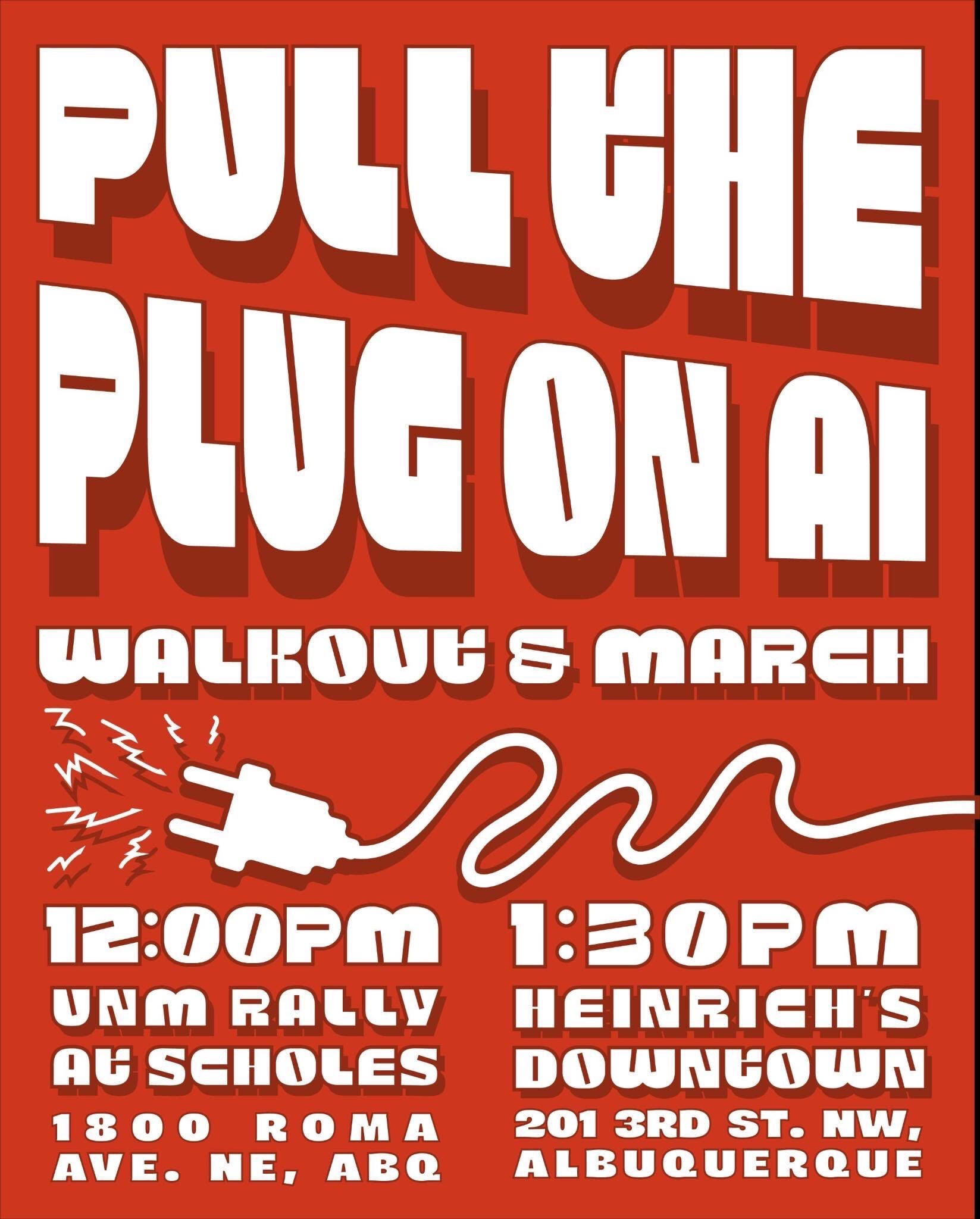
Youth United for Climate Crisis Action (YUCCA) invites Tribal organizations, environmental and community advocates, and allied organizations to join students and community members on Tuesday, October 27, for the “Pull the Plug on AI” Walkout & March, starting at the University of New Mexico and marching to Senator Martin Heinrich’s Albuquerque office (flyer attached).

The rally will raise concerns about the rapid expansion of large-scale data centers and the Bipartisan American Affordability and Jobs Act of 2026 (BAAJA), S. 5653, co-sponsored by Senator Heinrich. BAAJA could accelerate the approval of large-scale data centers at the expense of our lands, waters, communities, sacred places, and collective ability to participate in decisions that affect our futures. This demonstration is an opportunity to stand together across our communities and call attention to the implications of data centers and the proposed legislation.

Walkout and March Details

  • Date: Tuesday, October 27, 2026
  • Time: Walkout from UNM at 12:00 pm, start march at 12:30 pm, rally at Sen. Heinrich’s office at 1:30 pm
  • Starting location: University of New Mexico, Albuquerque
  • Rally location: Senator Martin Heinrich’s Albuquerque office (Downtown - 201 3rd St. NW)

Instagram

Youth United for Climate Crisis Action
New Mexico
10/27/2026 at 02:00PM

Tags: