The purpose of this
hearing
is to assess the challenge of oil and gas sector methane leaks from a
scientific, technological, and policymaking perspective. The hearing
will discuss the current scientific consensus regarding the role of
methane leaks as a driver of oil and gas sector methane emissions. The
hearing will highlight recent advances in innovative leak detection and
repair technologies, as well as the importance of deploying such
technologies broadly throughout oil and gas sector operations to achieve
large-scale reductions in methane emissions. Finally, the hearing will
examine research gaps related to oil and gas sector methane emissions
and opportunities for the Federal government to support scientific
research activities pertaining to oil and gas sector methane leaks.
Committee staff conclude that oil and gas companies are failing to
design, equip, and inform their Methane Leak Detection and Repair
(LDAR) activities as necessary to achieve rapid and large-scale
reductions in methane emissions from their operations. The sector’s
approach does not reflect the latest scientific evidence on methane
leaks. Oil and gas companies must change course quickly if the United
States is to reach its methane reduction targets by the end of this
decade. The Committee staff also learned that oil and gas companies
have internal data showing that methane emission rates from the sector
are likely significantly higher than official data reported to
EPA would indicate. A very significant
proportion of methane emissions appear to be caused by a small number
of super-emitting leaks. One company experienced a single leak that
may be equivalent to more than 80% of all the methane emissions it
reported to EPA – according to
EPA’s prescribed methodology – for all of
its Permian oil and gas production activities in 2020.
Witnesses:
Dr. David
Lyon,
Senior Scientist, Environmental Defense Fund
Atmospheric
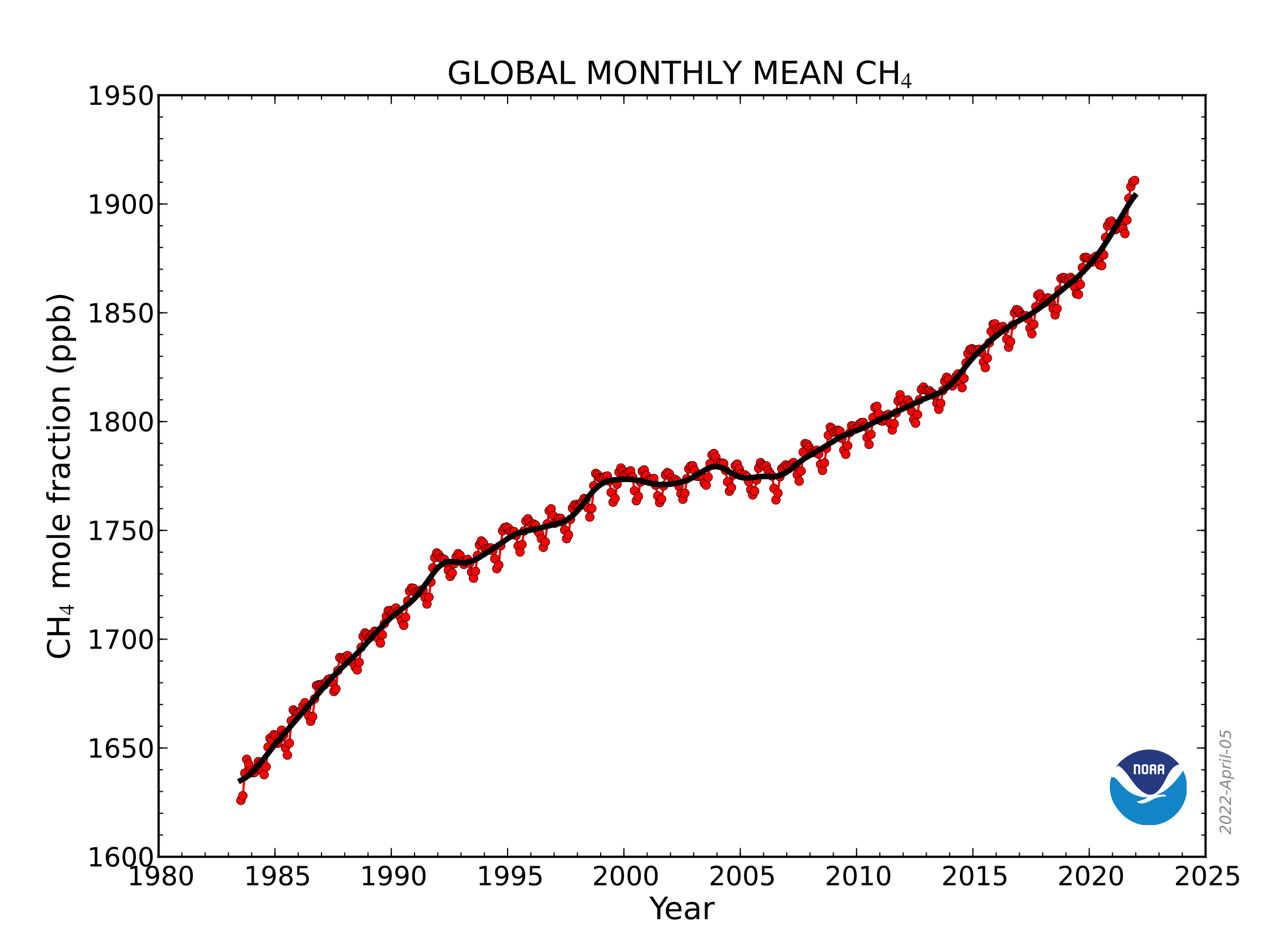
methane continues to rocket up at record rates,
NOAAreported
yesterday. As fracking booms, methane levels increased by 17 parts per
billion in 2021, breaking the 2020 record of 15.3 ppb. Concentrations of
this powerful greenhouse pollutant are now 162 percent of their
pre-industrial levels, as the Biden administration pushes for more
natural gas production and
export.
The essential Kate Aronoff castigates the
incoherence
of Democrats in Congress who claim to care about the climate crisis
begging oil CEOs to increase fossil-fuel production, instead of acting
to take their billions in windfall
profits
and stop their greenhouse pollution:
Appealing to these CEOs’ better angels is pointless. Although they
hand fossil fuel companies billions in subsidies each year, American
policymakers mostly confine themselves to begging or berating them
into doing what they want.
To harp on the climate crisis while doing nothing about it is, in the
long run, intolerable. Liberals’ failures make Trump look honest. He
may deny the science, but at least he’s true to himself.
The oft-repeated claim that the United States has significantly reduced
its greenhouse pollution since 2005 by switching from coal to gas
depends on the EPA’s official accounting that
methane pollution has declined during the fracking boom, an implausible
scenario.
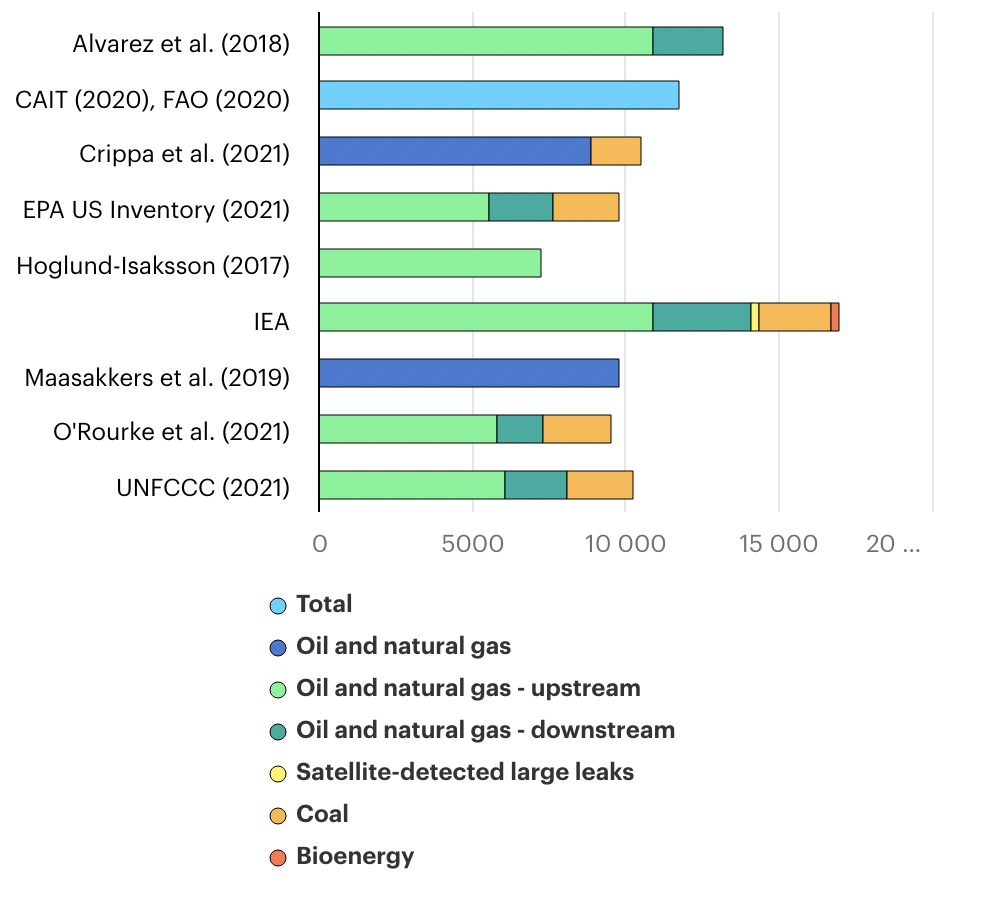
Today, the International Energy Agency revealed in a major report that
methane pollution from the fossil-fuel industry is 70 percent higher
than official figures globally. Their Global Methane Tracker finds that
the U.S. Environmental Protection Agency has been seriously
undercounting methane pollution. The IEA
estimate of 2021 methane pollution is 77 percent higher than the
EPA’s inventory:
United States methane pollution from energy sources in 2021.
EPA estimate: 9,600 kT;
IEA estimate: 17,000 kT
Not surprisingly, that cancels out all the purported climate
benefits
of switching electricity production from coal to natural gas.
Furthermore, the U.S. EPAcalculates
the effect of methane on global warming by using its impact over 100
years, which is about 30 times that of CO2, instead of more
scientifically defensible dynamic
measures
that take into account methane’s 20-year impact, which is 86 times that
of CO2.
3/7/20 Update: Russia invaded Ukraine the day after the
IEA report
dropped, so
that may help explain why this report didn’t get too much attention.
However, the oil and gas industry are claiming the invasion means we
have to drill everywhere, and the Senate Energy Committee found time to
attack FERC for regulating methane
pollution.
So I think there’s capacity to discuss this report and its shattering
implications, which include the need for the United States to shut down
the fracking boom as fast as humanly possible.
Join the U.S. EPA and U.S. Department of the
Army for an opportunity to comment on the proposed “Waters of the United
States” definition. This is the third of three public
hearings.
A public hearing to provide interested parties the opportunity to
present data, views, or arguments concerning the proposed rule typically
consists of morning, afternoon and evening sessions. In a virtual
environment, these hearing sessions will be held on different days. To
allow more time for speakers, the agencies prerecorded a video
introduction and overview of the rule.
The purpose of these
calls
is to inform communities about EPA’s
environmental justice work and enhance opportunities to maintain an open
dialogue with environmental justice advocates. As environmental justice
continues to be integrated into EPA programs
and policies, the Agency hopes that these calls will help reaffirm
EPA’s continued commitment to work with
community groups and the public to strengthen local environmental and
human health outcomes.
Registration:
Due to limited space, participation in this call will be on a first
come, first-served basis. Pre-registration is highly suggested, but not
required. If registration has reached capacity, please see the links
below for instructions on how to access the call if seating is available
on the day of the meeting. If you are unable to join the call, a summary
will be posted to the U.S. EPA Office of
Environmental Justice’s website after.
Interpretation: If you need English-language interpretation assistance,
or special accommodations for a disability or other assistance, you can
submit a request when registering for the meeting. Please submit your
request by September 23, to give EPA
sufficient time to process.
For more information about the National Environmental Justice Community
Engagement Calls, please visit the website or email: Victoria Robinson
([email protected]) or Christina Motilall
([email protected]).
On Wednesday, September 22, at 9:30 AM ET, the
Senate Committee on Environment and Public Works will hold a business
meeting to consider several of President Biden’s nominees, legislation
to rename federal buildings, and several General Services Administration
resolutions.
Immediately following the business meeting, the committee will hold a
hearing
on the importance of promoting a circular economy.
Jeffrey Prieto to be General Counsel of the Environmental Protection
Agency. He was a
member
of the Biden Agriculture transition team. He was a long-time
Department of Justice environmental lawyer who helped set up its
environmental justice division. His nomination hearing was on June
16.
Stephen A. Owens to be a Member of the Chemical Safety and Hazard
Investigation Board
Jennifer B. Sass to be a Member of the Chemical Safety and Hazard
Investigation Board
Sylvia E. Johnson to be a Member of the Chemical Safety and Hazard
Investigation Board
$408 million for the Department of Energy Office of Nuclear Energy
$20 million for the Department of Energy Office of Fossil Energy and
Carbon Management
$1.08 billion in general funds for Department of Energy National
Laboratories, including
$377 million for Office of Science
$210 million for Office of Energy Efficiency and Renewable Energy
$40 million for Office of Nuclear Energy
$190 million for Office of Fossil Energy and Carbon Management
$102 million for the Office of Environmental Management
$2 billion for fusion research and development
$1.1 billion for Office of Energy Efficiency and Renewable Energy
demonstration projects, including wind, solar, geothermal, hydropower,
vehicles, bioenergy, and building technologies
$70 million for a new Clean Energy Manufacturing Innovation Institute
$52.5 million for university nuclear reactor research
$10 million for demonstration projects on reducing the environmental
impacts of fracking
wastewater
$20 million for the Office of Economic Impact and Diversity
$50 million for the Office of the Inspector General
Environmental Protection Agency
$264 million to conduct environmental research and development
activities related to climate change, including environmental justice
FEMA
$798 million for Assistance to Firefighters Grants
NASA ($4.4 billion)
$4 billion for infrastructure and maintenance
$388 million for climate change research and development
NIST ($4.2 billion)
$1.2 billion for scientific and technical research, including
resilience to natural hazards including wildfires, and greenhouse gas
and other climate-related measurement
$2 billion for American manufacturing support
$1 billion for infrastructure and maintenance
NOAA ($4.2 billion)
$1.2 billion for weather, ocean, and climate research and forecasting
$265 million to develop and distribute actionable climate information
for communities in an equitable manner
$500 million to recruit, educate, and train a “climate-ready”
workforce
$70 million for high-performance computing
$224 million for phased-array radar research and development
 Atmospheric
methane continues to rocket up at record rates,